


If you own a home in Snohomish, your garage door probably gets more use than your front door. It works through wet winters and damp river valley mornings, and sooner or later it starts acting up. Some of those problems are a five-minute job you can handle with a rag and a can of lubricant. Others involve parts under enough tension to cause serious injury. This guide sorts one from the other, so you know when garage door repair in Snohomish is a Saturday morning project and when it is time to call a technician.
Quick Checks to Try Before You Call Anyone
Some garage door problems have a simple fix. Run through this list before you call.
- Check the power. Confirm that the opener is plugged in and the outlet works, and look for a tripped breaker or GFCI outlet.
- Replace the remote battery. If the wall button works but the remote does not, the battery is the likely cause.
- Look at the safety sensors. These are the two small units near the floor on each side of the door. If one gets bumped out of line or the lens is dirty, the door will refuse to close or will reverse partway down. Most have an indicator light that blinks or goes dark when something is wrong.
- Check the locks. Many wall controls have a lock setting that disables the remotes, and some doors have a manual slide lock on the inside.
- Clear the path. A rock, a toy, or a clump of wet leaves in the track or under the door can stop it cold.
If one of these solves the problem, you are done. If not, keep reading.
Garage Door Maintenance That Is Safe to DIY
These jobs do not involve springs or cables under tension, and most homeowners can handle them with basic tools and the owner’s manual.
Lubricating moving parts
A noisy door often just needs lubrication. Use the lubricant your door or opener manual recommends on the hinges and roller bearings, and never touch or adjust the springs while you work. Wipe dirt and grime out of the tracks with a damp rag. Our guide to why your garage door is so noisy covers this in more detail.
Cleaning and realigning the sensors
Wipe both lenses with a soft cloth. If the indicator light still shows a problem, loosen the bracket, adjust the sensor until the light holds steady, and tighten it again. Your opener’s manual shows the exact steps.
Tightening loose hardware
Every cycle sends vibration through the door, and over time the bolts on hinges and track brackets work loose. A socket wrench takes care of it. The one exception is the bottom bracket on each lower corner, where the lift cable attaches. That bracket holds the cable under tension, so leave it alone.
Replacing the bottom seal
A cracked or flattened bottom seal lets in rain, leaves, and cold air. On most doors, the old rubber slides out of a channel along the bottom panel and a new one slides in.
Testing the auto-reverse
The U.S. Consumer Product Safety Commission recommends testing your opener’s reversing feature every month. Follow the test steps in your opener’s manual. If the door does not reverse, adjust the opener as the manual describes or have a professional inspect it.
Why Springs and Cables Are Off-Limits?
The springs do the heavy lifting. The door itself is heavy, and the springs are what let you raise it with one hand. Torsion springs, mounted on a bar above the door, are wound tight to balance that weight. Extension springs, found along the tracks on many older doors, stretch every time the door closes. Either type stores enough energy to cause serious injury if it lets go, and winding a torsion spring takes specialized bars and a specific procedure.
Cables work hand in hand with the springs. A frayed cable can snap without warning, and loosening the bracket it attaches to can release that tension all at once.
Leave these jobs to a trained technician:
- Replacing or adjusting torsion or extension springs
- Replacing lift cables, drums, or pulleys
- Removing or adjusting the bottom brackets
- Putting a door back on its tracks
- Replacing bent track sections while the door is under spring tension
Spring choice matters too. A replacement has to match your door’s weight, or the opener ends up straining to make up the difference. We install high-cycle torsion springs rated for 10,000 to 30,000 cycles, matched to each door. Our post on warning signs you need spring replacement covers what to look for.
Signs It Is Time to Call a Pro for Garage Door Repair in Snohomish
Stop and call if you notice any of these:
- A loud bang from the garage, followed by a door that feels much heavier. That is often a broken spring.
- A visible gap in a torsion spring
- Frayed, loose, or slipping cables
- A door that hangs crooked or rollers that have left the track
- A door that slams shut or drops quickly instead of lowering smoothly
- An opener motor that runs while the door stays put, even after the quick checks
- An auto-reverse test that still fails after you have followed the manual
If a spring or cable has failed, do not try to open the door with the opener or by hand. Without the counterbalance, the full weight of the door can come down suddenly. Leave it where it is and call for emergency garage door service.
What Happens When You Call The Garage Door Guys
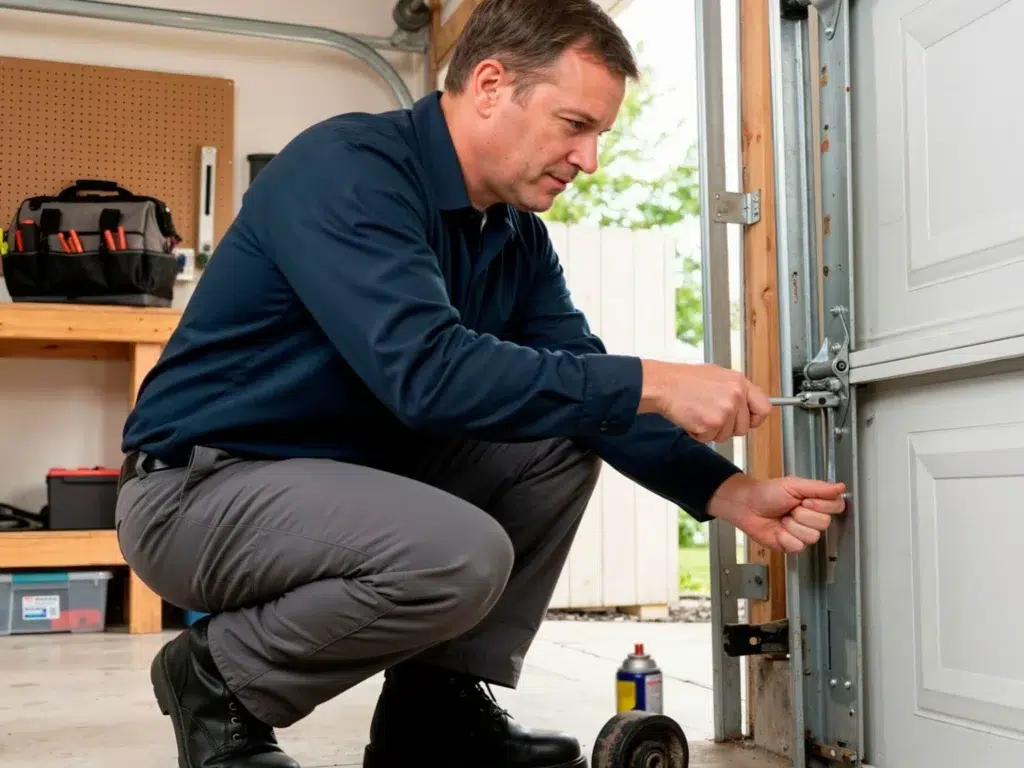
When you book a garage door repair in Snohomish, the technician inspects the whole system: springs, cables, rollers, tracks, panels, and the opener. You get a clear explanation and an itemized quote before any work begins, and nothing is repaired until you approve it.
Our service vehicles carry common springs, cables, rollers, and hardware, so most repairs are finished on the first visit, usually within one to two hours. Before we leave, we test the door’s balance and auto-reverse, run it through several cycles, and share a few maintenance tips. Same-day service is available when the schedule allows, and urgent problems get priority.
Frequently Asked Questions
Can I replace a garage door spring myself?
We strongly advise against it. Springs hold a large amount of stored energy, and winding or releasing them without the right tools and training can cause serious injury. A technician can replace the spring safely and match it to your door’s weight.
Why does my garage door start to close and then go back up?
The usual causes are dirty or misaligned safety sensors and something blocking the door’s path. Clean and realign the sensors and clear the area first. If the door still reverses, the opener’s settings may need adjusting, or something mechanical may be dragging on the door.
How often should a professional inspect my garage door?
We recommend a professional inspection at least once a year. It catches worn springs, frayed cables, and loose hardware before they turn into breakdowns. See our post on how often to schedule garage door maintenance in Snohomish for more.
My garage door is stuck open. What should I do?
Run through the quick checks first: power, sensors, locks, and anything in the door’s path. If it still will not close, or you see a broken spring or cable, do not force it. Call us and we will help get the door closed and your home secure.
Need Garage Door Repair in Snohomish? Call The Garage Door Guys
Basic upkeep is worth doing yourself, but springs, cables, and off-track doors belong in trained hands. If the quick checks did not fix your door, call The Garage Door Guys at (360) 863-2133 or request a free estimate. We are based at 127 Ave C Ste C, Snohomish, WA 98290, and serve homeowners throughout Snohomish County.